
- Why Installation Quality Has a Lasting Impact on Energy Bills
- What Poor Installation Costs Over Time in Dubai
- DEWA Tariffs Make Installation Quality Even More Important
- AC Installation Companies in Dubai — What Actually Separates Them
- AC Installation Cost Dubai — What to Expect
- AC Installation Sizing Guide for Dubai Properties
- What a Professional Extreme Cool Installation Visit Covers
- Real Example — AC Installation, The Springs Villa, February 2026
- How Extreme Cool Approaches AC Installation in Dubai
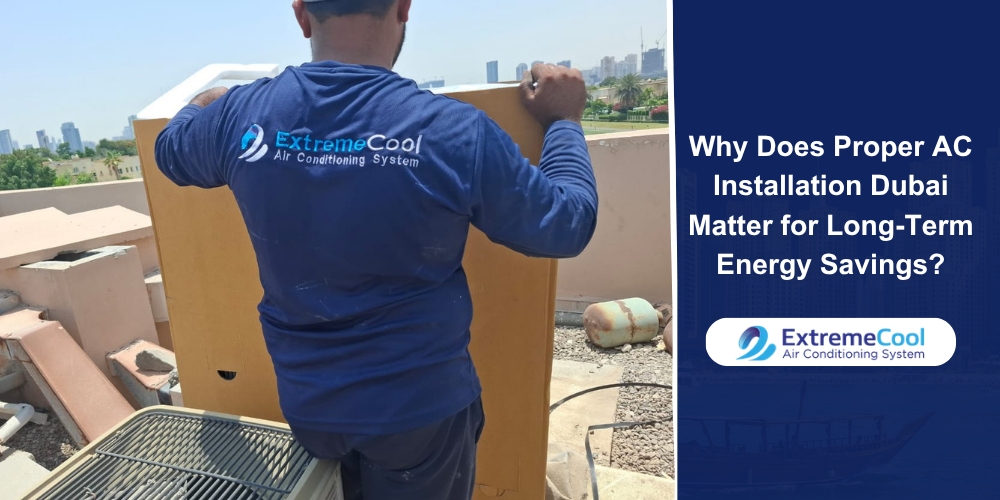
Most Dubai residents spend considerable time choosing the right AC unit, comparing brands, checking energy ratings, and comparing prices. What far fewer people consider is that the unit itself is only half the equation. Proper AC installation Dubai is what determines whether that unit actually delivers the performance it was built for. Two identical systems installed in similar properties can produce entirely different electricity bills and entirely different lifespans, and the difference almost always comes down to installation quality. For anyone planning a new installation or replacing an existing system, understanding what separates a proper installation from a standard one is worth the time before the work begins.
Extreme Cool is a Dubai Municipality licensed AC contractor providing professional AC installation in Dubai for residential and commercial properties across major communities including Jumeirah, Dubai Marina, The Springs, Meadows, Mira Oasis, and Downtown Dubai. Every installation begins with a full site assessment and heat load calculation — not an estimate, and is carried out to Dubai Municipality standards and manufacturer specifications.
According to DEWA’s energy efficiency guidelines, air conditioning accounts for approximately 70–80% of total residential electricity consumption during Dubai’s summer months. The quality of installation is the single variable most within a property owner’s control when it comes to managing that figure from day one.
Why Installation Quality Has a Lasting Impact on Energy Bills
The relationship between installation quality and electricity consumption is not immediately obvious to most property owners, but it is consistent and measurable. A system that has been correctly sized, correctly charged with refrigerant, and correctly connected to a sealed duct network operates within the efficiency parameters it was designed for. One that has not will draw more electricity for every hour it runs, for as long as it runs.
The first is unit sizing. An oversized system short-cycles, switching on and off more frequently than a correctly sized unit, consuming additional electricity with each restart and never running long enough to properly dehumidify the air. An undersized system runs almost continuously, working at or near full load throughout the hottest hours to maintain a temperature it was not built to handle for that space. HVAC industry data consistently shows that oversized or undersized systems consume 20–30% more electricity than correctly matched units.
The second is refrigerant charge. Every AC brand specifies an exact refrigerant charge for each model. Even a 10–15% deviation from that specification, in either direction, affects how efficiently the compressor reaches the set temperature. An undercharged system runs longer cycles. An overcharged system builds excess pressure that reduces efficiency and accelerates component wear. Getting this right at installation, using brand-specific refrigerant and the correct charge weight, is not something that can be corrected later without a service visit.
The third is ductwork integrity. For ducted villa systems in Dubai, leaky or poorly insulated ductwork is one of the most common and least visible causes of high electricity bills. Ducts run through ceiling voids where summer temperatures can exceed 60°C. Without proper insulation and sealed joints, cooled air loses temperature before reaching the rooms it was designed for. The system compensates by running longer. The bill rises accordingly, and the owner rarely connects the cost to the installation that caused it.
What Poor Installation Costs Over Time in Dubai
The financial case for investing in a quality installation is straightforward when the numbers are laid out across a typical Dubai operating cycle.
| Factor | Correctly Installed AC | Poorly Installed AC |
| Daily run hours — peak summer | 10–12 hours | 14–18 hours |
| Monthly kWh — peak summer | 900 – 1,100 kWh | 1,400 – 1,800 kWh |
| Monthly DEWA bill — peak summer | AED 350 – 450 | AED 550 – 750 |
| Compressor lifespan | 10–15 years | 5–8 years |
| Annual repair frequency | Low | Significantly higher |
| First major repair timeline | 8–12 years | 3–6 years |
Estimates based on standard 1.5–2 ton split AC in a medium Dubai apartment. Figures vary by brand, insulation quality, and thermostat habits.
The monthly bill difference of AED 200–300 on a single unit compounds significantly across a typical Dubai summer. Over five months of peak usage, that gap represents AED 1,000–1,500 per unit in excess electricity costs — from the same model, in a similar space, with the difference originating entirely in how each system was installed.
Add the shortened compressor lifespan, and the true cost of a poor installation becomes considerably larger than the initial saving from choosing a cheaper contractor.
DEWA Tariffs Make Installation Quality Even More Important
Dubai’s tiered electricity tariff structure means that higher consumption is not simply charged at a flat rate — each additional band of consumption is charged at a higher rate per unit. An AC system that consistently pushes a property into a higher consumption band does not just cost more because it uses more electricity. It costs more because it uses more electricity at a higher rate per unit.
DEWA Residential Electricity Tariff — Dubai
| Monthly Consumption | Rate Per kWh AED |
| 0 – 2,000 kWh | AED 0.23 |
| 2,001 – 4,000 kWh | AED 0.28 |
| 4,001 – 6,000 kWh | AED 0.32 |
| Above 6,000 kWh | AED 0.38 |
Verify current rates at dewa.gov.ae/en/
A villa running a poorly installed ducted system that pushes monthly consumption from 3,500 kWh to 5,000 kWh does not just pay for 1,500 extra units at the base rate. Those extra units fall into a higher tariff band, compounding the monthly impact. Bringing consumption down through correct installation moves the household into a lower band, reducing the effective rate paid on every unit consumed, not just the additional ones.
AC Installation Companies in Dubai — What Actually Separates Them
The difference between AC installation companies in Dubai is most visible not in their quoted price but in what they do before and during the installation itself.
A proper installation begins with a site visit before any pricing is confirmed. The technician assesses the space, measuring rooms, checking ceiling heights, reviewing window orientation and sun exposure, evaluating insulation, and confirming the electrical supply capacity. From that assessment, a heat load calculation determines the correct system capacity per room or zone. This process takes time and cannot be replaced by a square-metre estimate.
During the installation itself, refrigerant is charged using brand-specific type and weight, not a generic fill to rough pressure. Duct connections are sealed and insulation applied to manufacturer specifications. The electrical connection is sized correctly for the load and tested before the system is commissioned. A full performance test confirms cooling output and, for ducted systems, airflow balance across all ceiling vents before handover.
The best AC installation companies in Dubai issue a written handover record confirming the work carried out, the refrigerant charge weight, the operating pressures at commissioning, and any observations about the property’s electrical supply or existing infrastructure. This document serves as the baseline for future maintenance visits and supports manufacturer warranty claims if required.
AC Installation Cost Dubai — What to Expect
Understanding approximate costs helps in budgeting and in evaluating quotes from different providers.
| System Type | Approximate Cost AED |
| Split AC 1–1.5 ton — supply and install | AED 800 – 1,500 |
| Split AC 2 ton — supply and install | AED 1,500 – 2,500 |
| Cassette AC unit — supply and install | AED 2,500 – 4,500 |
| Multi-split system — 2 zones | AED 4,000 – 7,000 |
| Ducted central AC — per zone | AED 4,000 – 9,000+ |
| Villa full ducted system — 4 zones | AED 15,000 – 40,000+ |
Market estimates only. Final costs depend on brand, capacity, existing infrastructure, and site conditions. Contact Extreme Cool for a fixed quote following a site visit.
A quote that comes without a site visit should be treated with caution, the price cannot reflect the actual requirements of the property, and the difference between a quoted estimate and the actual scope of work often surfaces after the job has begun.
AC Installation Sizing Guide for Dubai Properties
Getting capacity right is the most impactful single decision in any installation. The table below gives general guidance for Dubai apartments and villas.
Apartments
| Apartment Size | Recommended Capacity |
| Studio — up to 35 sqm | 1.0 – 1.5 ton split |
| 1-bedroom — 35–60 sqm | 1.5 – 2.0 ton split |
| 2-bedroom — 60–100 sqm | 2.0 – 2.5 ton split or cassette |
| 3-bedroom — 100–150 sqm | 2.5 – 3.5 ton — multiple units |
| Large apartment 150 sqm+ | 3.5 ton+ or cassette system |
Villas
| Villa Size | Recommended System |
| Up to 150 sqm | 3–4 ton split or small ducted |
| 150 – 300 sqm | 5–8 ton ducted central system |
| 300 – 500 sqm | 8–14 ton ducted — multi-zone |
| Above 500 sqm | 14 ton+ — multiple outdoor units |
These are starting guides only. Actual requirements depend on ceiling height, insulation quality, window area, sun orientation, and occupancy. A heat load calculation is always recommended before finalising capacity.
What a Professional Extreme Cool Installation Visit Covers
- Site assessment — Technician visits the property, measures all rooms or zones, reviews ceiling heights, window orientation, sun exposure, and existing electrical supply
- Heat load calculation — Exact cooling capacity calculated per zone based on all conditions — not a square-metre estimate
- System recommendation — Right unit type, brand, and capacity recommended with a written quote before any work begins
- Unit procurement — Genuine units sourced directly from authorised brand suppliers
- Installation day — Indoor and outdoor units mounted, refrigerant lines connected, ductwork installed and sealed where applicable
- Refrigerant charging — Charged to exact manufacturer specification for the specific brand and model; leak-tested before commissioning
- Electrical connection — Wiring and breaker ratings verified and confirmed against load requirements
- Airflow balance — For ducted systems, airflow confirmed at every ceiling vent before handover
- Test run and handover — Full system run confirms cooling output; customer walked through basic operation and maintenance schedule
- Written installation record — Operating pressures, refrigerant charge weight, and findings documented and issued to the property owner
Real Example — AC Installation, The Springs Villa, February 2026
A villa owner in The Springs contacted Extreme Cool after receiving three installation quotes ranging from AED 24,000 to AED 41,000 for a full ducted replacement, all three without a site visit. Extreme Cool’s technician carried out a full property assessment before quoting, including a heat load calculation across four zones.
The assessment found that the previous system had been significantly oversized for two of the zones, a main bedroom and a guest room, explaining the short-cycling and humidity complaints the owner had experienced for years. The correct specification came in at 9.5 tons across four zones rather than the 12-ton system two of the other contractors had proposed.
After installation at the correct capacity with fully insulated and sealed ductwork, the villa’s first full summer DEWA bill averaged AED 980 per month. The owner had been paying AED 1,340 per month with the previous oversized system under similar usage conditions, a monthly difference of AED 360 attributable entirely to correct installation.
How Extreme Cool Approaches AC Installation in Dubai
Extreme Cool’s installation process does not begin with a unit recommendation. It begins with understanding the property. Whether it is a studio apartment in Downtown Dubai or a five-bedroom villa in Mira Oasis, the approach is the same: assess the space accurately, calculate what the cooling load actually requires, source the right unit for those conditions, and install it to the exact specification of the brand being used.
Their technicians are trained across all major AC brands in use across Dubai residential and commercial properties and carry brand-specific parts and refrigerants on their service vehicles. Every installation is carried out to Dubai Municipality standards and results in a written handover record the property owner can rely on for future maintenance and warranty support.
For properties where an existing installation has been driving up electricity bills, Extreme Cool also provides AC maintenance Dubai and AC repair Dubai services — giving property owners a single reliable contractor across all AC requirements.
Final Words
Proper AC installation services in Dubai is not a detail — it is the foundation that determines what a system costs to run, how long it lasts, and how reliably it performs across years of heavy use. Getting capacity right, charging refrigerant to specification, sealing ductwork properly, and connecting the electrical supply correctly are decisions made once at installation but paid for — or saved through — every month for the life of the system. Extreme Cool provides AC installation in Dubai backed by site assessment, heat load calculation, and manufacturer-compliant installation across all major Dubai communities. For energy efficiency guidance, DEWA provides practical resources at dewa.gov.ae/en/consumer/energy-and-water-efficiency. Contact Extreme Cool for a site assessment before the summer season begins.
Read Also: Change Nationality on Iqama KSA (Steps + Documents)
FAQs
1. Who should carry out AC installation in Dubai to ensure long-term energy savings?
A Dubai Municipality licensed contractor that performs a full heat load calculation before recommending any system is the right starting point. The calculation needs to account for ceiling height, sun exposure, window area, insulation quality, and occupancy — not just floor area. A technician who cannot explain why a specific capacity was chosen for a specific space is estimating, not calculating. Extreme Cool carries out a documented heat load calculation on every property before any unit is recommended or quoted.
2. What is the AC installation cost in Dubai for a standard apartment?
A standard split AC installation for a 1.5-ton unit in a Dubai apartment typically runs between AED 800 and AED 1,500 including supply and installation. A 2-ton unit ranges from AED 1,500 to AED 2,500. Cassette units for larger open-plan spaces start from AED 2,500. These are market estimates, the actual cost depends on the brand, existing electrical supply, and pipe routing requirements. Extreme Cool provides a fixed quote following a site visit, not an estimate over the phone.
3. When is the best time to book an AC installation in Dubai?
Between October and February is the recommended window. Booking in this period avoids the summer rush when AC installation companies in Dubai are at their busiest, allows time for a proper site assessment and any infrastructure adjustments, and provides a test period before peak cooling demand begins. Extreme Cool accepts bookings year-round for urgent requirements, but the pre-summer window is the most practical for planned installations.
4. What makes the best AC installation companies in Dubai different from cheaper alternatives?
The difference shows up before any unit is mounted. The best AC installation companies in Dubai visit the property, carry out a heat load calculation, confirm the electrical supply, and explain their capacity recommendation in writing before the quote is finalised. During installation, they charge refrigerant to brand-specific specification, seal all duct connections, verify electrical load ratings, and test airflow at every vent. They issue a written installation record at handover. Contractors who skip these steps may quote less upfront, but the difference in electricity bills and repair costs over time is consistently larger than the initial saving.
5. How much does incorrect AC installation cost a Dubai homeowner over time?
A system that is oversized or undersized by even one capacity tier consumes 20–30% more electricity than a correctly matched unit. For a typical Dubai villa running peak summer for five months, that difference can amount to AED 1,500–2,500 in excess electricity costs per year — per unit. Add a shortened compressor lifespan of 5–8 years rather than 10–15, and the cost of a poor installation relative to a professional one becomes significant within the first three to four years of operation.