
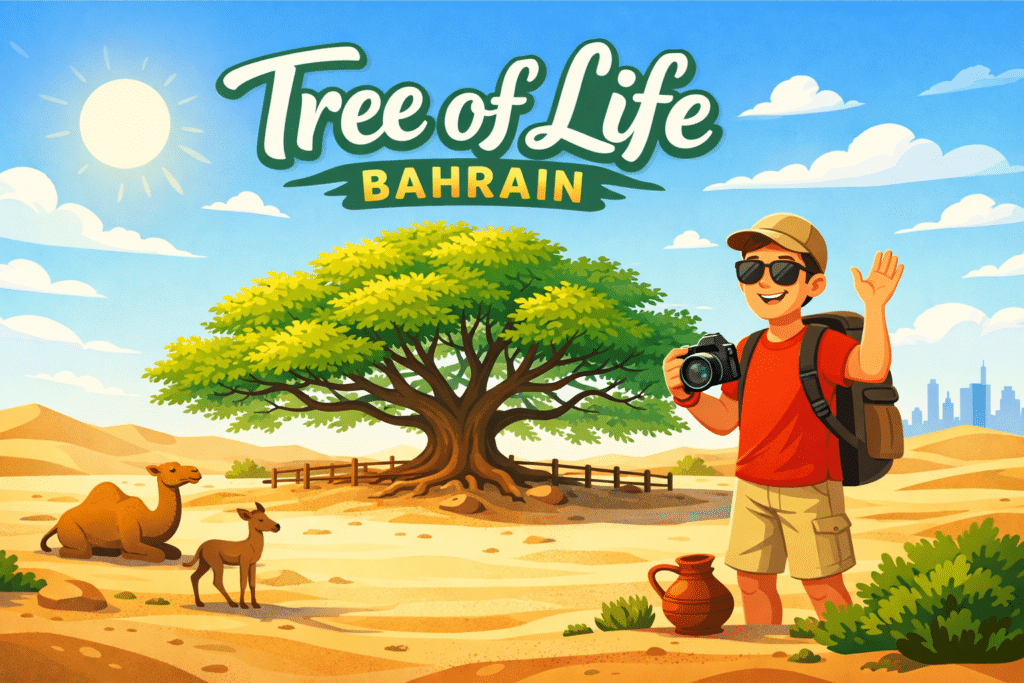
Have you not seen a tree living hundreds of years in the midst of a desert, on no apparent source of water? Tree of Life Bahrain is added to the list of a small number of other locations that will stop and make you reflect on the actual processes of nature. It is a place where there is mystery, nature, and history in one place, and that is why you should give it your one hundred percent attention.
In this guide, all the details about the Tree of Life Bahrain are included, including its history, where it is located, scientific theories about it, myths and facts, and tips on how to travel there.
What is Tree of Life Bahrain?
The Tree of Life is a lone tree in Bahrain’s Sakhir desert, usually described as a ghaf – Prosopis Cineraria (Ghaf tree) – though botanists still debate its exact species. It stands in the desert region of Sakhir, Bahrain. It measures 9-10 meters in height and has emerged as one of the best-known natural locations across the entire nation.
Location of Tree of Life Bahrain
The Tree of Life is a desert plant appearing in the desert of Sakhir in Bahrain, roughly 35–40 km south of the capital, Manama.
Key Location Details:
- Area: Sakhir Desert, Bahrain
- Distance from Manama: Around 40 km
- Nearby landmark: Jebel Dukhan (Bahrain’s highest point)
- Environment: Isolated desert location with sand.
Getting here means driving or taking a taxi, as this is the best means of transport in this area. The direction to the tree has been well marked, and there are indicators that would guide the tourists.
History of Tree of Life Bahrain
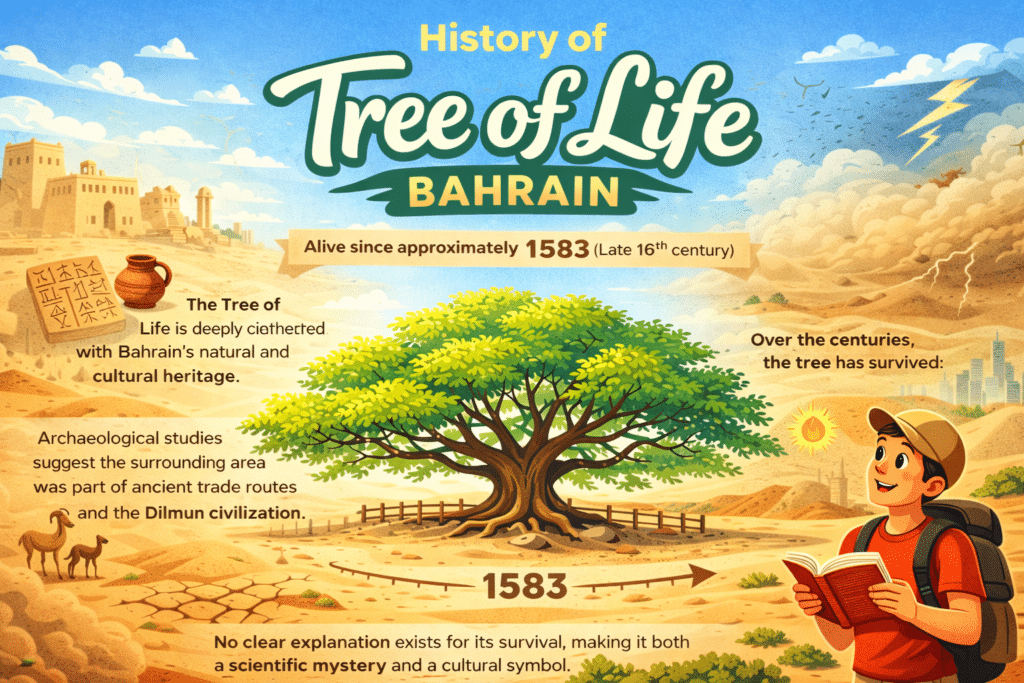
The history of the Tree of Life is closely associated with the natural and cultural heritage of Bahrain. There has been very little documentation of its age, but tests in the 1990s suggested it took root around 1582–1583, which would make it more than 400 years old.
Archaeological studies indicate that the region was once surrounded by the ancient trade routes and might even have been connected with the Dilmun civilization, one of the oldest in the region.
Over the centuries, the tree has survived:
- Extreme drought conditions
- Desert storms
- Rising temperatures
- Human curiosity and tourism pressure
The most intriguing aspect of its history is that there is no conclusive explanation as to how it managed to survive. The doubt about it has made the Tree of Life a scientific enigma as well as a cultural icon.
Why Does the Tree of Life Survive in the Desert?
Among the largest questions that people do not hesitate to ask is How does the Tree of Life survive without water? Several theories are trying to explain this natural phenomenon:
Deep Root System Theory
Scientists are of the opinion that the tree could have very deep roots up to 50 meters or so underground–and so enabling it to reach underground water.
2. Underground Water Source Theory
According to some experts, maybe, there may be concealed underground aquifers in the region of Sakhir that provide moisture to the trees.
3. Moisture Absorption from Air
According to another theory, it is possible that the tree would absorb water via humidity in the air in infrequent climatic situations.
4. Scientific Uncertainty
Scientific explanations are yet to be proved, though studies have been carried out.
5. Mythical Interpretations
Locals will tend to give reasons of spiritual or historical reasons, that nature or some ancient powers protect the tree.
Tree of Life Bahrain Facts
The following are some of the rapid and interesting facts about this natural wonder:
- Belongs to the Ghaf tree species (Prosopis cineraria)
- Height: Around 9–10 meters
- Estimated age: 400+ years
- It is situated in one of the driest deserts in Bahrain.
- Receives thousands of visitors each year.
- Has no obvious water source nearby.
- Withstands harsh desert conditions.
These facts underscore the reason why this tree is not merely a plant; it is a natural phenomenon of the world.
How to Visit Tree of Life Bahrain
These days the tree sits inside a low circular fence that protects it from cars and vandalism. A small visitor area has displays on the site’s history, including pottery found around the tree, and there’s a little amphitheatre for occasional events. Come early in the morning or near sunset – the midday heat is brutal for much of the year and there’s very little shade.
The Tree of Life itself is an easy yet memorable place to visit.
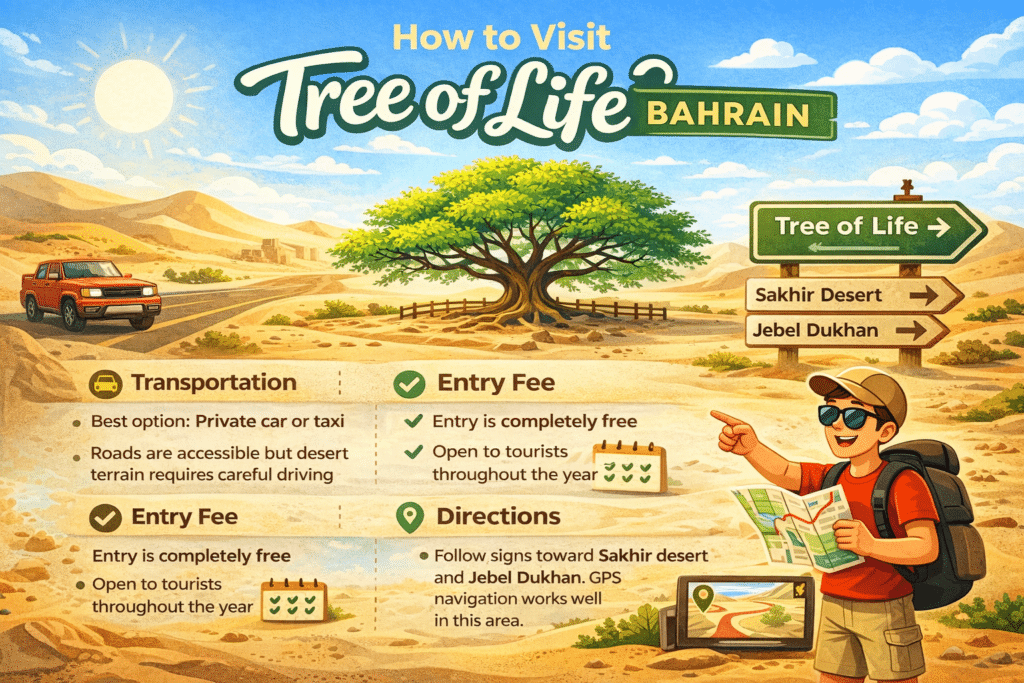
Transportation
- Best option: Private car or taxi
- There are good roads, and special care must be taken when driving over desert terrain.
Entry Fee
- Entry is free, and the site is open daily from 6am to 10pm
- Available to tourists all year round.
Directions
Turn towards the Sakhir desert and Jebel Dukhan. The GPS positioning can be efficient in this location.
Things to Do Near Tree of Life Bahrain
Its attraction is the tree, but there are other places of interest nearby:
1. Desert Photography
Take shots of beautiful desert scenes and the famous solitary tree.
2. Visit Bahrain International Circuit
This Formula 1 circuit is a key tourist destination in the area.
3. Jebel Dukhan Exploration
The topography of Bahrain is the highest natural point that has scenic views.
4. Sunset Viewing
One of the most serene activities in Bahrain is the desert sunset.
FAQs About Tree of Life Bahrain
1. What is the reason why the Tree of Life is famous in Bahrain?
It is renowned for having survived in a desert with no apparent source of water for centuries.
2. How old is the Tree of Life?
It is approximated to be more than 400 years old.
3. Is it natural or man-made?
It is completely natural.
4. Is it possible to see the Tree of Life, which was visited by tourists?
Yes, it can be visited even during the whole year.
5. What is its survival mechanism?
The cause is yet not established clearly, though deep roots and underground water are the top theories.
Read Also: How to Renew CPR in Bahrain 2026: Online & In-Person
Living in Bahrain or planning a longer stay? These guides may help: the Bahrain postal code guide, how to renew your CPR in Bahrain, and our Bahrain driving test appointment guide.
Final Thoughts
The Tree of Life Bahrain is not a mere desert tree but a rare natural phenomenon that, even to this day, still asks questions. It is one of the most interesting landmarks in the region as it can survive in such harsh conditions. Considered as either a scientific mystery or a natural miracle, it is apparent how uncertain and strong nature can be.
This offers a meaningful experience to the visitors without saying a word; one can experience it in the desert. It is not about seeing a tree, but telling its story and how it belongs to its environment, a mystery that surrounds it.