Last updated: September 2026 – wording corrected and references checked.
What can be considered the major sins in Islam, and why must every Muslim know about them? Learning the greatest sins (Kabair) in Islam is not an ordinary Islamic religious know-how; it is a highway to a harmonious, pious, and firm standing life. These are the obvious sins which are clearly taught in the Quran and taught by the Prophet Muhammad, which show what one is to avoid because of saving the faith, personality, and society. Most of us are seeking easy explanations for these sins, yet most of the time we end up with little information because some details are incomplete and may be hard to comprehend.
This manual is authored to simplify matters. Here, you will encounter a clear and human interpretation of the 15 great sins in Islam, the meanings of the same, and their consequences in the Hereafter (Qayamat).
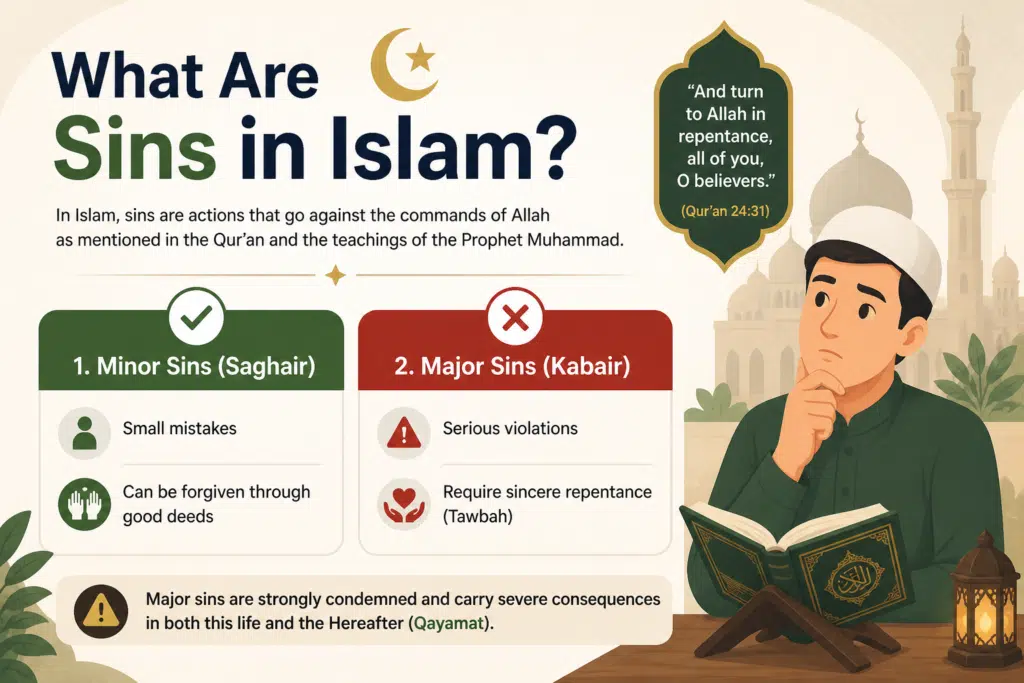
What Are Sins in Islam?
In Islam, sins are actions that go against the commands of Allah as mentioned in the Qur’an and the teachings of the Prophet Muhammad.
Sins are divided into two main categories:
1. Minor Sins (Saghair)
- Small mistakes
- Can be forgiven through good deeds
2. Major Sins (Kabair)
- Serious violations
- Require sincere repentance (Tawbah)
There are major sins that are highly discouraged and carry a stern penalty in this life as well as in the Hereafter (Qayamat).
Laws in Saudi Arabia Related to Major Sins
Saudi Arabia has a multitude of laws affected by Islamic rules:
- There is a prohibition on alcohol.
- Theft and other crimes are prosecuted in the courts, where Sharia principles guide the law.
- Public decency rules apply, and dress or behaviour that breaks them can bring fines.
- Visitors and residents are expected to show respect for religious practice and holy sites.
Nonetheless, their implementation is subject to change, and newer reforms have brought some flexibility in certain directions.
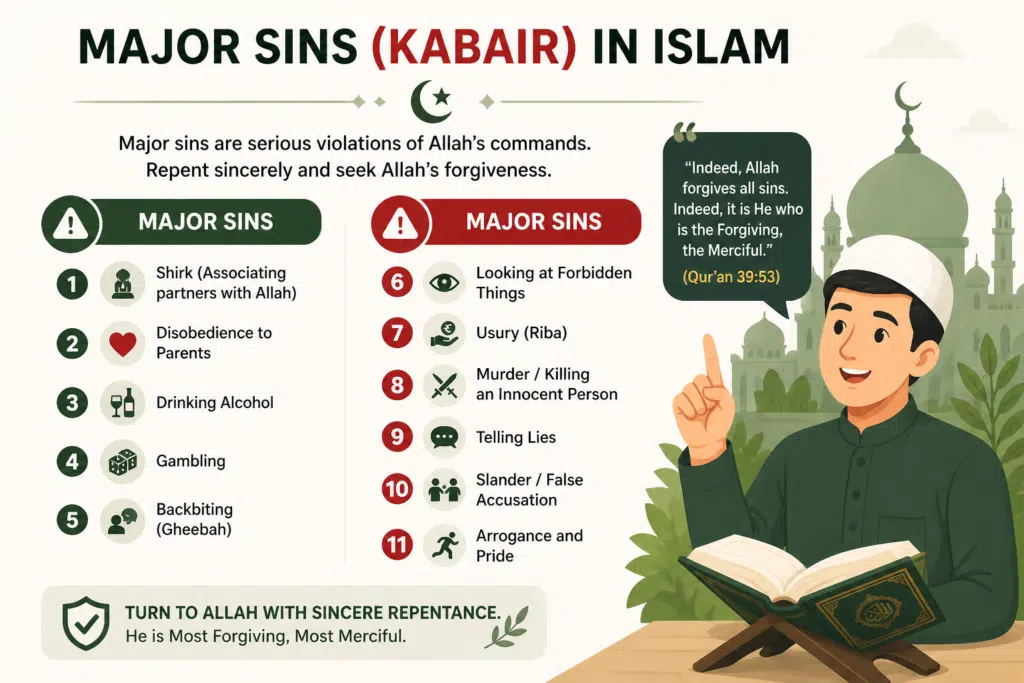
15 Major Sins in Islam
Scholars don’t all agree on one fixed number of major sins. A well-known hadith in Bukhari and Muslim names seven ‘destroying’ sins, including shirk, magic, unjust killing, consuming riba and taking an orphan’s wealth, while the classical scholar al-Dhahabi listed around seventy in his book al-Kaba’ir. The fifteen below are among the most widely discussed, so treat this as a starting point rather than a complete list.
The 15 major sins are fully detailed and explained in an easy-to-understand and human way below so that the readers can comprehend the meaning and implications of these sins.
1. Shirk (Associating Partners with Allah)
Shirk refers to the belief or worshiping anything other than Allah, or attributing any divine qualities to anyone or anything. It is the greatest sin in Islam as it corrupts the pillar of faith (Tawheed). Even slight types of shirk, such as offering demonstrations of worship with an aim of praise is hazardous.
- Qur’an: Allah does not forgive associating partners with Him if one dies without repentance (4:48)
In Qayamat:
A person who dies on shirk will fail to go into Paradise. It is the sin that can forever stop salvation.
2. Murder (Unjust Killing of a Human Being)
Human life is extremely important in Islam. An unjust execution is regarded as one of the most atrocious acts in Islam. It disintegrates families and creates mayhem in society.
- Qur’an: Killing one innocent soul is like killing all humanity (5:32)
In Qayamat:
The killer will be harshly punished and stand before Allah to answer for it, and the victim’s rights will be settled first.
3. Theft (Stealing Others’ Property)
The term theft indicates seizing what does not belong to you. Islam greatly discourages it as it kills trust and economic equity in society.
- Qur’an: The punishment for theft is clearly defined as a serious offense (5:38)
In Qayamat:
All stolen goods will be credited. The thief shall not get rewards but shall be humiliated till justice is enhanced.
4. Adultery (Zina)
Any sexual relationship outside marriage is termed as Zina. Islam not only forbids nearness, it also harms families, society, and morals.
- Qur’an: Do not even approach adultery, it is a shameful act (17:32)
In Qayamat:
It causes tough punishment and loss of dignity in the Hereafter without the need to repent.
5. Drinking Alcohol (Intoxicants)
Alcohol destroys self-control, causes crime, and destroys mental health. As a whole, Islam does not permit it to safeguard people and society.
- Qur’an: Intoxicants are from Satan’s work, so avoid them (5:90)
In Qayamat:
An individual who dies without repentance can be punished and forfeit the divine mercy.
6. Lying and False Testimony
Falsehoods kill trust, and false confessions can kill innocent souls and the criminal justice system.
- Hadith: The Prophet warned that false testimony is among the greatest sins (Bukhari & Muslim)
In Qayamat:
All the lies will be uncovered. The individual will be answerable for all the wrongs he brought about through his words.
7. Disrespecting Parents
The rank of parents in Islam is very high. Dishonoring them is a great sin since it disintegrates the structure of a family.
- Qur’an: Do not even say “uff” to your parents (17:23)
In Qayamat:
Whoever disrespects parents might lose the mercy of Allah and would be subject to serious consequences.
8. Bribery and Corruption
Bribery is giving or taking money to influence decisions unfairly. It leads to injustice in government, business, and society.
- Hadith: The Prophet cursed the giver and taker of bribes (Tirmidhi)
In Qayamat:
Both will be condemned to the spreading of corruption and injustice.
9. Interest (Riba)
Riba denotes gaining money inappropriately through systems of interest. It takes advantage of the poor and heightens inequality.
- Qur’an: Allah has forbidden interest and allowed trade (2:275)
In Qayamat:
People concerned with riba will lose their wealth, and blessings will be taken away.
10. Backbiting (Gheebah)
Backbiting means speaking about someone’s faults behind their back. Even if true, it is still considered sinful.
- Qur’an: Backbiting is like eating the flesh of your dead brother (49:12)
In Qayamat:
The individual will part ways with virtuous actions and be responsible of ruining the reputation of others.
11. Breaking Promises
Breaking your word shows a lack of honesty and integrity. According to Islam, keeping promises is an indication of faith.
- Hadith: Breaking promises is a sign of hypocrisy (Bukhari)
In Qayamat:
Such a person will be questioned about their dishonesty and broken trust.
12. Arrogance (Pride)
Arrogance refers to the denial of the truth and feeling superior to others. It is a spiritual malady that kills humility.
- Hadith: No one with even a small amount of arrogance will enter Paradise (Muslim)
In Qayamat:
The arrogant will be disgraced and could be refused entry to Paradise.
13. Oppression (Zulm)
Oppression means harming others, denying rights, or being unjust in any form.
- Hadith: Oppression will become darkness on the Day of Judgment (Bukhari & Muslim)
In Qayamat:
Violence will be punished with the oppressors, who will be severely punished until no victim is left without justice.
14. Magic and Sorcery
Magic entails making use of malicious supernatural powers, and this is outrightly prohibited in Islam since it is faith-destroying.
- Qur’an: They learned what harms them and does not benefit them (2:102)
In Qayamat:
Scholars class sorcery as a grave sin that can take a person out of faith if they don’t repent.
15. Suicide
Suicide is the self-administration of death, which is unethical since life is a gift bestowed to a person by Allah.
- Hadith: Whoever kills himself will be punished repeatedly in the Hereafter (Bukhari)
In Qayamat:
The hadith warns of lasting punishment for taking a life that Allah entrusted to the person.
Difference Between Cultural Norms and Religious Sins
Not all that is perceived to be inappropriate is a sin.
Religious Sins
- Clearly defined in Islam
- Based on the Qur’an and the Hadith
Cultural Norms
- Vary by region
- May change over time
Interpreting this difference serves to be confusing.
Frequently Asked Questions (FAQs)
Which is the greatest sin in Islam?
Associating partners with Allah is the greatest sin, Shirk.
Is Saudi Arabia prohibited from alcohol?
Yes, alcohol is both forbidden religiously and legally.
Can tourists be punished for breaking rules?
Yes, tourists must follow local laws and can face penalties.
What does Qayamat mean in Islam?
Qayamat is the Judgment Day, when everything is recorded.
Do we punish every sin in this world?
No. Some sins carry worldly penalties, but most are left to Allah’s judgement, and sincere repentance can bring forgiveness.
Read Also: Certificate of Employment Saudi Arabia (2026 Guide)
Final Thoughts
It is not merely the issue of learning the religious rules; it is the development of awareness that will enable an individual to live responsibly, respectfully, and in clarity according to the major sins in Islam. To anyone who lives in, works in, or travels to Saudi Arabia, this knowledge becomes all the more significant in that it assists you in realizing the moral and cultural values that influence day-to-day life.
Knowing about these teachings will mean that you can stay out of the way of causing anyone any harm or staying out of the way of violating the local traditions, as well as being able to enjoy what is on the ground in the way of religion.