
A prepaid SIM card is a mobile SIM that lets you pay for calls, text messages, and mobile data before you use them. You pay for services as you go, either by adding credit or buying a “mobile package” up front, then use them until your credit runs out or the package expires. It provides you much useful flexibility in connectivity and simultaneously allows you to have control on your mobile bills.
You will understand what a prepaid SIM card is and how it works, its pros and cons, how it compares to a postpaid, and what to take into consideration in picking the correct one.
What Is a Prepaid SIM Card?
This is a SIM card that is paired with a cellphone service plan for which fees for the mobile service are paid in advance for calls, SMS, and mobile data. Users can buy one of the prepaid SIMs, refill credit, or subscribe to any package before using any services provided by them.
The word “prepaid” refers to the payment method, not the physical SIM technology. In simple terms, you pay for mobile services before using them rather than paying for your usage through a monthly bill.
How Does a Prepaid SIM Card Work?
A prepaid SIM card operates on the premise of paying for a card in advance with the mobile network operator. You activate the SIM, top up your credit or choose a package, then you take advantage of the services provided by your package.
Here is how the process works.

Step 1: Purchase a Prepaid SIM Card
Choose a mobile operator that provides prepaid services in your country. You can usually obtain a SIM through an operator’s store, an authorised retailer, or an official online channel.
Before purchasing, compare network coverage, initial costs, available packages, and registration requirements.
Step 2: Register and Activate Your SIM
Once you get the SIM, follow the instructions provided by the operator for activation.
A prepaid SIM card is a type of SIM that operates by prepaying for any calls it will support. You buy or activate the SIM, top up the credit or choose a package, and then you use the services you have in your package.
Step 3: Add Credit or Purchase a Package
Depending on the operator, you may have two main options:
- Add prepaid balance: Add money to your cellphone account. When using services or getting bundles, the operator takes off applicable charges.
- Purchase a prepaid package: Buy the package and receive a fixed amount of data, which you will be allowed (for example, 10GB), as well as a fixed number of calling minutes (for example, 100 calling minutes).
Several plans offer both types of capitalization. For instance, you can buy a package of included services, but still have extra account credit to spend on services not in the package.
Step 4: Use Calls, Text Messages and Mobile Data
Once you receive credit or check out a package, you can enjoy the benefits of your membership or package.
These may include:
- Making and receiving voice calls.
- Sending and receiving SMS messages.
- Browsing websites and using online applications.
- Watching videos and streaming content.
- Using maps, navigation, and email.
- Accessing other mobile network services.
Amounts available on your balance or package are dealt with as per the rates of the operating service provider.
Step 5: Recharge or Renew Your Package
If your credit is used up when you have just finished your package or it keeps running out, you might need to top up your balance or Sign Up for a New Package.
Because of this, keep an eye on your remaining balance, data allowance, and package expiry date regularly.
What Is Included in a Prepaid SIM Card?
A useful prepaid SIM will not come with a set amount of data, calling minutes or text messages. Services are based on the package you buy and the service you are offered by the operator.
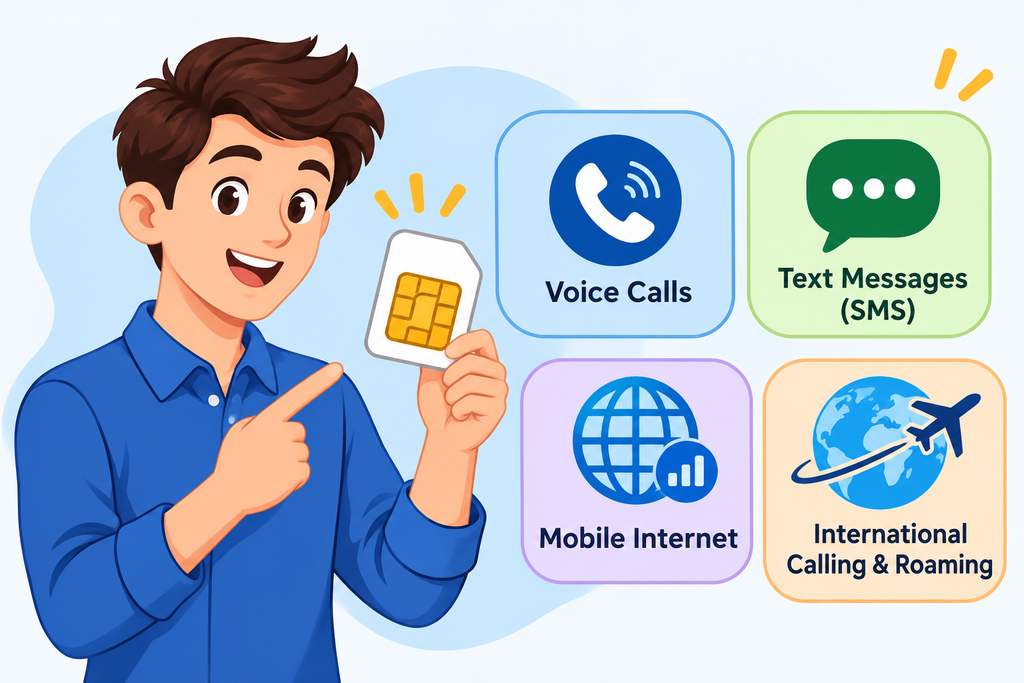
Common prepaid services include:
1. Voice Calls
Prepaid packages may come with local telephone call minutes, unlimited calls to certain networks or calling on the basis of the amount of the call.
Be sure to find out if the package’s minutes are valid for all networks or certain operators before buying it. A separate package or credit may be needed to pay for international calls.
2. Text Messages (SMS)
A lot of flexiblewalls packages contain a predetermined number of Sms. permits. Other operators charge you from your balance when you send messages.
International SMS rates may differ from domestic messaging charges.
3. Mobile Internet
A prepaid data package enables you to use your mobile network to connect to the internet.
Depending on the package, you may be getting a daily, weekly or monthly data allowance. Certain operators even provide social media packages, data-only packages and offers of unlimited data with speed or Fair Usage limits.
4. International Calling and Roaming
Some prepaid services offer international calls and international roaming.
Availability and roaming charges, however, vary from provider to provider, country to country, and package to package. Domestic prepaid does not always mean International roaming.
What Are the Different Types of Prepaid SIM Plans?
There are various payment and package options for prepaid services. By knowing these choices, you’ll be able to select a plan that fits your usage.
| Prepaid plan type | How it works | Suitable for |
|---|---|---|
| Pay-as-you-go | Credit is deducted as you use chargeable services | Occasional callers |
| Data package | Provides a fixed amount of mobile data | Internet users |
| Calling package | Includes a specific number of call minutes | Frequent callers |
| Combined bundle | Includes data, calls and sometimes SMS | Regular mobile users |
| Daily package | Remains active for a short specified period | Short-term needs |
| Weekly package | Provides allowances for a week | Flexible users |
| Monthly prepaid plan | Offers allowances for a defined monthly period | Regular users |
| Auto-renewing prepaid plan | Renews automatically under its payment conditions | Users who prefer continuity |
A monthly prepaid package should not be confused with a postpaid subscription. A prepaid plan can last 30 days while still requiring payment before the next period begins.
What Can You Do With a Prepaid SIM Card?
A prepaid SIM card can provide a number of services that are similar to those that are offered by a postpaid SIM card. The primary variation is in the means of payment for those services.
Make and Receive Phone Calls
Prepaid SIMs are used to make and receive calls via their mobile network. Call charges can be deducted from your usage or as part of an active package.
Unlimited local calls are available, or some include a fixed number of minutes.
Send and Receive SMS Messages
Typically, prepaid SIM cards are capable of enabling regular SMS. Messages can be sent and received along with verification codes, account notifications, and more.
The price charged for sending messages; this can vary according to provider and package.
Access the Internet
Mobile data enables you to access online applications, view websites, check your emails, participate in social networks, stream videos, and so much more — anywhere, anytime, for free.
Use Messaging Applications
You can use applications such as WhatsApp, Telegram, and other internet-based messaging services with a prepaid SIM, provided you have an active internet connection.
Some applications may require a phone number for account registration or verification.
What Types of Prepaid SIM Cards Are Available?
There are various options and types of prepaid SIM cards. Learning all about these options can help you select one that will fit your mobile and cell needs.
Physical Prepaid SIM Card
Physical prepaid SIM cards are the ones that you can remove from a mobile phone lock and fit another in instead. It holds information related to the subscriber and assists your handset in accessing the mobile network.
There are various sizes of physical SIM cards, such as standard, micro, and nano. The majority of the latest cell phones have nano SIM cards.
Prepaid eSIM
Prepaid eSIM is a SIM that is digital and can be downloaded and activated on a compatible device. The major difference from a physical SIM is that a removable plastic card is not required for the eSIM. It is typically possible to activate it with a QR code or via digital activation instructions from the operator.
Prepaid eSIMs are a great choice for users who don’t want to find a new SIM card to insert into their mobile phone when they travel.
Local Prepaid SIM Card
A prepaid mobile phone SIM card is a specific one that is issued by a cell phone company in a certain nation. It is widely used by those living, visiting, and travelling within the area who require local mobile services.
A traveler, for instance, might buy a local SIM for the country they are travelling to in order to obtain cheap data and calling services in that nation.
International Travel SIM Card
International prepaid cards are for those who will need to travel between countries. They can be provided for various destinations with mobile data, voice calls, and SMS services.
Which countries it covers, what network partners it has to work with, what data caps are there on it, data roaming restrictions, and data validity time.
How Do You Buy and Activate a Prepaid SIM Card?
The purchase of prepaid SIM cards and activation is relatively easy. The procedure may vary according to your country and cellular service provider, though.

Follow these steps to get started.
Step 1: Choose a Mobile Network Provider
Know what you may have in your neighborhood of network providers to use.
Consider:
- Network coverage.
- Mobile data speeds.
- Available prepaid packages.
- Calling and SMS rates.
- Recharge methods.
- SIM validity conditions.
- Customer support.
Select a provider that provides coverage in the areas where you typically use your phone.
Step 2: Check Your Phone Compatibility
When looking to buy a SIM card, you need to ensure that your phone has the proper network technology and frequency bands, as these are essential to the service.
With an eSIM, check if your device has eSIM support and if the provider’s plans work with eSIMs.
Step 3: Purchase the SIM Card
A prepaid SIM can usually be bought from:
- Official mobile network stores.
- Authorised retailers.
- Supermarkets and convenience stores.
- Official operator websites.
- Approved online sellers.
A handful of companies offer starter packages to include a first balance or package.
Step 4: Complete Registration and Activation
Insert your physical SIM card or follow the activation instructions for your eSIM. A valid ID and SIM registration will probably be required depending on the local requirements.
Follow the provider’s instructions to activate your mobile number.
Step 5: Choose a Prepaid Package
Once activated, be sure to see what packages are available and choose the appropriate one for your needs.
Look at the package price, data cap, calling minutes, SMs caps, and period.
Step 6: Test Your Mobile Connection
Once everything is activated, test your SIM card. Try making a call, sending a text message, and accessing the internet.
If something does not work, check your phone settings, network coverage, account balance, and activation status. Contact your provider if the problem continues.
Frequently Asked Questions (FAQs)
1. What is the difference between a prepaid SIM and a regular SIM?
A regular SIM card is a broad term for a subscriber identity module that supports a portable device on a network. A prepaid cellphone SIM is one that is linked to a prepaid service plan, which needs to be paid for before it is utilized.
2. Do prepaid SIM cards have phone numbers?
Yes. Most of the prepaid SIM cards do come with a mobile telephone number that makes it possible to make and receive calls and SMS messages.
3. Can you use a prepaid SIM card in any phone?
A prepaid SIM may be used in a SIM-supported, network-unlocked phone and on the operator’s network technology. Some SIM cards do not support all devices or mobile carriers.
4. Do prepaid SIM cards expire?
There can be rules on validity and inactivity with Prepaid SIMs. Some will need to have recharges or transactions on an account to maintain a number.
Read More: UAE Traffic Fines: Check, Pay & Avoid Penalties (2026)
Final Thoughts
A prepaid SIM is essentially a bespoke cellular service alternative that permits users to pay for calls, messages, and mobile data prior to using them. For certain individuals who desire a controlled handle on their phone charges, a temporary link to the mobile network, or aren’t driven to settle on a long-term mobile contract, it might be a convenient option.
Prepaid plans do come with their share of drawbacks, however, such as package expiry dates, package size issues, and limitations on international roaming.